1989 Mazda Miata vs. 2026 Mazda Miata: How Much Has Changed in 37 Years
Few sports cars have earned the kind of reputation enjoyed by the Mazda Miata. Since its debut in 1989, the lightweight roadster has become a global icon, celebrated for its simple formula of low weight, balanced handling, and open-top driving fun. While countless sports cars have come and gone over the past 37 years, the Miata has remained remarkably true to its original mission.
At first glance, the 2026 Mazda Miata still looks instantly recognizable as the spiritual successor to the original. It remains a compact, rear-wheel-drive convertible with a naturally aspirated four-cylinder engine and a strong focus on driver engagement. However, beneath its familiar silhouette, nearly every component has evolved. From performance and safety to technology and comfort, the latest Miata is a far more advanced machine than the one that first captured enthusiasts’ hearts in 1989.
Here’s a closer look at just how much has changed—and what has stayed the same.
Exterior Design
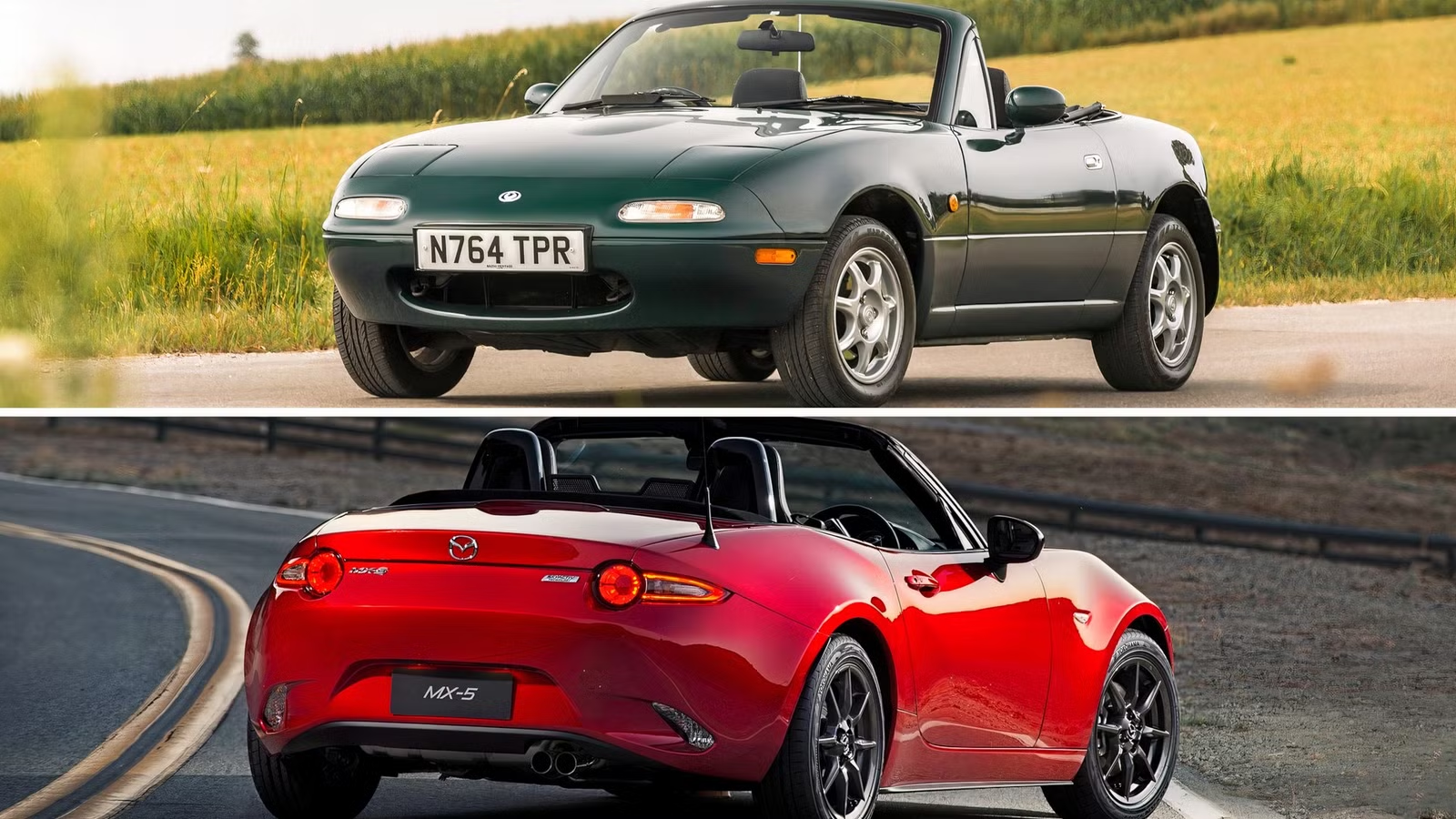
The first-generation Miata embraced a timeless, minimalist design inspired by classic British roadsters. Its pop-up headlights, rounded body panels, and compact proportions gave it an unmistakable personality that quickly became iconic.
The 2026 model takes a more modern approach while preserving the original’s compact dimensions. Sharper body lines, sculpted fenders, LED lighting, and a wider stance give the latest Miata a more aggressive appearance without sacrificing its approachable character.
Despite decades of evolution, both cars share the same basic philosophy: lightweight styling with every curve serving a purpose.
Dimensions
Although the modern Miata is slightly larger, it remains one of the smallest sports cars on sale.
Compared with the original model, the latest version offers:
- A slightly wider body for improved stability.
- Increased chassis rigidity.
- Better aerodynamics.
- More efficient use of interior space.
- Improved crash protection.
Mazda has carefully controlled the car’s growth, ensuring it never loses the nimble feel that defines the Miata experience.
Engine Evolution
The 1989 Miata featured a 1.6-liter naturally aspirated four-cylinder engine producing modest horsepower by today’s standards. While it wasn’t especially fast, its willingness to rev and light curb weight made every drive enjoyable.
The 2026 Miata continues using a naturally aspirated four-cylinder engine, but decades of engineering improvements have transformed its performance.
Modern enhancements include:
- Higher horsepower.
- Increased torque.
- Improved fuel efficiency.
- Lower emissions.
- Faster throttle response.
- More refined engine management.
Even with greater performance, Mazda has resisted the industry trend toward turbocharging, preserving the immediate throttle response enthusiasts appreciate.
Transmission
One of the Miata’s defining characteristics has always been its manual gearbox.
The original five-speed manual earned praise for its short, precise shifts and mechanical feel.
The 2026 model continues that tradition with an even smoother and more refined six-speed manual transmission. Buyers who prefer convenience can also choose an automatic transmission, but the manual remains the favorite among driving enthusiasts.
The gearshift still delivers the satisfying precision that helped make the Miata famous.
Chassis and Handling
Handling has always been the Miata’s greatest strength.
The 1989 model featured:
- Rear-wheel drive.
- Near-perfect weight distribution.
- Double-wishbone suspension.
- Lightweight construction.
- Excellent steering feedback.
The 2026 Miata builds on that foundation with stronger chassis construction, updated suspension geometry, improved dampers, and more sophisticated electronic systems.
The result is even greater cornering confidence while maintaining the playful character that made the original legendary.
Weight
One of the most impressive achievements of the modern Miata is how little its weight has increased.
While many sports cars have gained hundreds of pounds due to additional technology and safety equipment, the Miata remains remarkably light.
Mazda has carefully used lightweight materials and efficient engineering to ensure the latest model still delivers agile handling and quick responses.
This commitment to low weight remains central to the Miata’s identity.
Interior Design
Step inside the 1989 Miata, and simplicity immediately stands out.
The dashboard featured straightforward analog gauges, physical controls, and very few distractions. The focus was entirely on driving.
The 2026 cabin is considerably more sophisticated while remaining driver-focused.
Improvements include:
- Higher-quality materials.
- Better seating comfort.
- Improved ergonomics.
- Digital displays.
- Larger infotainment screen.
- Premium trim options.
- Better storage solutions.
Despite these upgrades, the cockpit still feels intimate and centered around the driver.
Technology
Technology has changed dramatically over nearly four decades.
The original Miata offered little beyond a radio and manual climate controls.
Today’s Miata includes numerous modern conveniences, such as:
- Smartphone integration.
- Bluetooth connectivity.
- Navigation.
- USB charging ports.
- Premium audio systems.
- Digital driver information displays.
- Voice control.
These features improve daily usability without overwhelming the driving experience.
Safety Improvements
Safety standards have evolved enormously since 1989.
The original Miata was built before many of today’s crash regulations existed.
The 2026 version benefits from decades of engineering advances, including:
- Multiple airbags.
- Electronic stability control.
- Traction control.
- Anti-lock brakes.
- Advanced crash structures.
- Blind-spot monitoring.
- Lane departure warning.
- Automatic emergency braking.
These systems make the modern Miata significantly safer while preserving its lightweight philosophy.
Ride Quality
The original Miata delivered a firm but comfortable ride that emphasized road feel.
The modern version achieves a better balance between comfort and performance.
Improved suspension tuning and structural rigidity allow the latest Miata to absorb road imperfections more effectively while remaining responsive during spirited driving.
Highway refinement has also improved considerably.
Fuel Efficiency
Advancements in engine technology have helped improve fuel economy over the years.
Modern fuel injection systems, improved aerodynamics, lighter components, and more efficient transmissions allow the 2026 Miata to deliver better efficiency while producing substantially more performance than the original.
Drivers benefit from lower running costs without sacrificing driving enjoyment.
The Driving Experience
Although almost every component has been updated, the Miata’s core personality remains remarkably consistent.
Both generations prioritize:
- Lightweight construction.
- Rear-wheel drive.
- Balanced handling.
- Open-air driving.
- Driver engagement.
- Mechanical simplicity.
Few sports cars have preserved their original mission as successfully as the Miata.
Why the Miata Still Matters
The automotive industry has changed dramatically since 1989.
Sports cars have become larger, heavier, more powerful, and increasingly reliant on electronic systems. Many manufacturers have abandoned affordable roadsters altogether.
The Miata stands apart by remaining faithful to a simple idea: driving should be enjoyable regardless of speed.
Its continued success proves that enthusiasts still value balance, communication, and driver involvement over outright performance figures.
Final Thoughts
Comparing the 1989 Mazda Miata with the 2026 model reveals an impressive story of careful evolution rather than radical transformation. The latest Miata is faster, safer, more comfortable, more efficient, and packed with modern technology, yet it never loses sight of the qualities that made the original such a beloved sports car.
Mazda has achieved something few automakers manage over multiple decades: improving nearly every aspect of a vehicle while preserving its original spirit. The 2026 Miata offers all the advantages of modern engineering without sacrificing the lightweight, rear-wheel-drive driving experience that enthusiasts have cherished since 1989.
Thirty-seven years after the first Miata appeared, its formula remains as relevant as ever. In an automotive world increasingly dominated by SUVs, electrification, and automation, the Miata continues to prove that sometimes the purest driving experiences are also the most enduring.